
"Chinese coffee agriculture"
1000 article(s) found

The respective expressions and questions of the introduction years of Zhukula Coffee in Chinese Coffee Culture
1.1 I remember that it was still the spring of 1995, when Professor Mao Genhai of the former South China Hot farming Academy and I went to Xishuangbanna, Yunnan Province. I had the honor to see Huang Junxiong and Zhang Xingcan, Institute of Tropical and Subtropical Coffee, Yunnan Academy of Agricultural Sciences, published a paper on the development of Yunnan coffee in 1994 in the third issue of Tropical crop Science and Technology, from which we got the information about the earliest introduction of Yunnan coffee.

Introduction of Seedling raising in Yunnan producing area of Chinese Coffee Plantation
Introduction to the Seedling raising of Chinese Coffee Plantation in Yunnan Province Liu Jiahua's home is located in Nanping Town, Simao District, Pu'er City, Yunnan Province, a village in the semi-mountainous area. He said that now that the picking season has just entered, 70 to 80 percent of the coffee beans will be ripe in half a month, and workers will have to pick them at that time, Liu Jiahua said. Looking at this coffee forest that has entered the picking period, Liu Jiahua is the most

Cats poop coffee ASEAN Expo revealed itself
On the morning of September 3, the 10th China-ASEAN Expo Agricultural Exhibition was held in Guangxi Exhibition Hall. ASEAN brand coffee, Chinese high-quality fruits, fine silk, fine agricultural machinery in China and Taiwan, etc. 11 countries concentrated on the exhibition. Cat poop coffee from Indonesia has attracted the attention of many citizens. According to Indonesian exhibitors, wild civets grow in Indonesia at an altitude of 2000 meters.

History of introduction and expansion of Coffee in early China (5)
1. From the first peak period of the development of China's coffee industry (1952-1961) to the late 1940s, according to recorded figures, there are 2173.33 hectares of rubber plantations in Hainan Island, with a total of 867600 rubber trees, with an annual output of 199,000 tons of dry rubber, and more than 300,000 coffee plants. the annual output of coffee beans is 1 ton. According to a survey in the early 1950s, there was a large amount of coffee left in Fushan area of Chengmai County, with a total of 70,000.
The "living fossil" of Chinese coffee
In early May, the reporter accompanied more than 60 domestic and foreign experts and scholars to Zhukula Village, Pingchuan Town, Binchuan County, to investigate one of the birthplaces of Chinese coffee and the only model of Zhukula Coffee Forest that has been inherited for more than a hundred years. There are the purest and most primitive coffee beans in the world, which have high historical and scientific research value, and can be called the living fossils of Chinese coffee. As soon as I entered the village, I faced
Yunnan Manlaojiang Coffee Manor is just to awaken your beauty.
Yunnan Jisi Trading Co., Ltd. was established in April 2006, the company's business scope is: domestic trade, material supply and marketing; import and export of goods and technology; processing of agricultural products; is a comprehensive import and export enterprise mainly engaged in coffee, cassava and other cash crops processing and sales, and obtained the record certificate of export food production enterprises in the State Commodity Import and Export Inspection and Quarantine Bureau. Public
A preliminary study on the Origin, Development, spread and Beverage Culture of Coffee
Coffee, tea and cocoa are the three major beverages in the world, which are consumed by about LM people all over the world, and their consumption is second only to drinking coffee in Europe and the United States. Coffee consumption is also becoming more and more popular in China and other eastern countries. However, in Chinese academic circles, there are no papers and monographs on coffee from the perspective of agricultural history and custom history.

Fine Coffee Common sense Chinese Herbal Coffee
Coffee is the first of the three major beverages in the world, one of the most important international trade commodities, and also an important raw material for medicine, food and light chemical industry. in history, there was only woody coffee in the world. and mainly produced in Colombia, Brazil, Indonesia and other countries near the equator, only a small amount of woody coffee is grown in subtropical areas such as Hainan and Yunnan, and coffee is not produced in most countries.
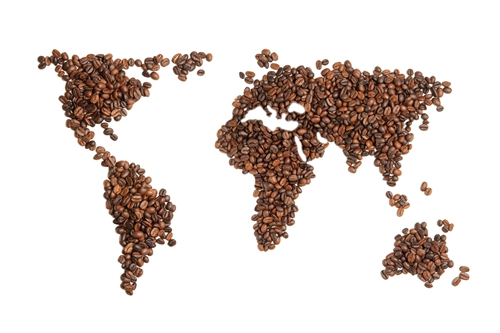
Pu'er Coffee fragrance "Belt and Road Initiative" Chinese Coffee producing area Yunnan small Coffee
Pu'er is known not only as the tea city of China, but also as the coffee capital of China. Coffee industry has become one of the characteristic agriculture in Pu'er plateau and an important pillar industry in the construction of national green economy experiment and demonstration zone. With the east wind of Belt and Road Initiative, coffee carries the dream of Pu'er people to the world. The cultivation of Pu'er coffee began at the end of the 19th century, and its industrialization began in 1988.
Looking for Dream Binchuan Zhu Kula Coffee
It is said that in the late Ming and early Qing dynasties, a man surnamed Qi and a woman surnamed Li met because of Zhu Kula. they lived in a shed leaning on mountains and water; they slept at night and multiplied; men ploughed and women weaved, picked fishing and hunting, and finally had Zhu Kula village. the whole village is dominated by villagers surnamed Qi and Li.

The development of Chinese coffee Dehong Hougu Coffee and its rise!
Dehong Hougu Coffee Co., Ltd. is a national key leading enterprise in agricultural industrialization. The company was established in December 2007 with a registered capital of 329 million yuan. By the end of 2014, the company had total assets of 4 billion yuan, sales income of 1.5 billion yuan and export earnings of 140 million US dollars. The existing staff of nearly 2000 people, under the Mangshi, Yingjiang, Kunming, Lincang, Longchuan, instant powder and other nine sub-companies. At present

With the rapid development of coffee in China, there has been a qualitative breakthrough in the planting area and total output.
According to current market data, emerging countries represented by China, Brazil, Russia, India and South Africa currently consume 20% of the world's coffee, which will reach 35% by 2020. Domestic consumers have a growing demand for coffee. In recent years, the world coffee giants have seized the Chinese market, and domestic coffee companies have also begun to build local coffee brands.
Coffee introduced into China and Chinese Coffee Culture
There are several meanings to say that coffee was introduced into China: first, coffee was introduced into China and was initially consumed by European and American people who came to China; second, there were commercial cafes where ordinary people, Chinese and foreign people could drink and entertain themselves; and third, coffee was cultivated in the field in China, produced and sold for its own use.

Liu Minghui, chairman of Aiyi Group, gave a speech on "Let Chinese Coffee fly" and set an example of CCTV.
Agricultural Credit Silver Cup 2015CCTV Model selection and Promotion activities for Agriculture, Rural areas and Farmers to the recent Kunming Entrepreneurship Summit roadshow, Liu Minghui, chairman of Aiyi Group, as the only selected entrepreneur in Yunnan, made a speech on the roadshow to make Chinese coffee fly, telling about his entrepreneurial path and dreams in humorous language. Liu Minghui: I think I am a person in an enterprise.

Introduction to the spread and Development Prospect of Coffee in China
The spread and development of coffee in China the history of coffee introduced into China is not long. It was not until 1884 that coffee was first planted in Taiwan Province of China. In the mainland of the motherland, the earliest coffee cultivation began in Yunnan. At the beginning of the 20th century, French missionaries brought the first batch of coffee saplings to Binchuan County, Yunnan Province, and began to grow coffee in the mainland. Chinese people already drink tea.
Coffee planting History of Coffee introduction and expansion in China in the early stage (5)
1. From the first peak period of the development of China's coffee industry (1952-1961) to the late 1940s, according to recorded figures, there are 2173.33 hectares of rubber plantations in Hainan Island, with a total of 867600 rubber trees, with an annual output of 199,000 tons of dry rubber, and more than 300,000 coffee plants. the annual output of coffee beans is 1 ton. According to a survey in the early 1950s, there was a large amount of coffee left in Fushan area of Chengmai County, with a total of 70,000.

A comparison between Chinese Tea Culture and Western Coffee Culture
Tea, coffee and cola are regarded as the three major drinks in the world, and the largest consumption is tea and coffee. Coffee is a substitute for coffee in the life of westerners, no matter at school, in the company, or at home as usual, everyone enjoys it with a coffee cup, while tea is hard to change in Chinese life. It is not only a kind of drink, but also carries Chinese and Chinese culture. Tea and coffee represent
Chinese Fine Coffee Pu'er Manor of Fine Coffee beans in Yunnan, China
Professional coffee knowledge exchange more coffee bean information Please follow the coffee workshop (Wechat official account cafe_style) in 1892, when the French missionary successfully planted the first coffee tree in a place called Zhukula in order to meet his own coffee needs, he might not have thought that a hundred years later coffee would become a highlight of Yunnan plateau characteristic agriculture. Yunnan in the 1950s

Description of Historical and Cultural Origin and Flavor of Chinese Coffee cultivation introduction of Grinding scale varieties
Description of the Historical and Cultural Origin of Coffee in China Flavor description Grinding scale Variety introduction Coffee production in Yunnan Province has been developed since the mid-1950s, mainly planted in Shuangjiang Farm and Dehong Sub-Bureau in Lincang area, covering an area of 18.67 hectares. it is also planted in small areas in Shaofang, Hekou, Lujiang, Jinghong, Olive Dam and other fields. Since 1957, the local environment is suitable for coffee growth.

Coffee book recommendation: the first Chinese coffee history book "Chinese Coffee History"
With the arrival of the third wave of coffee, domestic coffee enthusiasm is also rising. Coffee shops one after another, in the streets and commercial centers, coffee consumers, enthusiasts and baristas are increasingly tracing the origins of coffee and doing everything they can to understand it. In the bookstore and online, there are all kinds of coffee books, including coffee tasting and coffee making teaching.